Full text
Just a few years ago, many companies saw a website only as a simple online business card. A page with contact details, a few pieces of information and a basic overview of services was often enough.
Today, the situation is completely different.
For most companies, the website is the first place where a customer forms an opinion about the brand, the level of service and the company’s credibility. It is often the very first contact with a customer even before a phone call, meeting or inquiry.
That is why today a quality website does not simply mean “having a page.” It means looking professional, credible and showing that the company operates in a modern, clear and transparent way.
Many companies still think they do not need a website or that it is not important for their industry. In reality, customers commonly search for information online even about companies that work mainly offline or through referrals. If a company has no website, it often creates the impression that it has fallen behind the times or does not pay attention to its presentation.
Outdated websites are just as problematic. Old information, broken links, outdated contact details or a design that feels ten years old can quickly reduce customer trust even before the first contact.
A good website does not have to be overloaded with effects, complex animations or dozens of subpages. In many cases, less is more.
For many companies today, the ideal solution can be a simple, clear and well-crafted landing page where a customer understands within a few seconds what the company does, why to contact it and what services it offers.
The most important thing is that a visitor can orient themselves quickly and easily find the basic information. The menu must be clear, links must work, contacts must be easy to see and the whole website should feel current and professional even on mobile devices.
Speed and the technical quality of the website also play a major role today. Modern websites should be secure, properly hosted, regularly updated and prepared from the perspective of data protection or cookies. Yet many companies still forget about exactly these things.
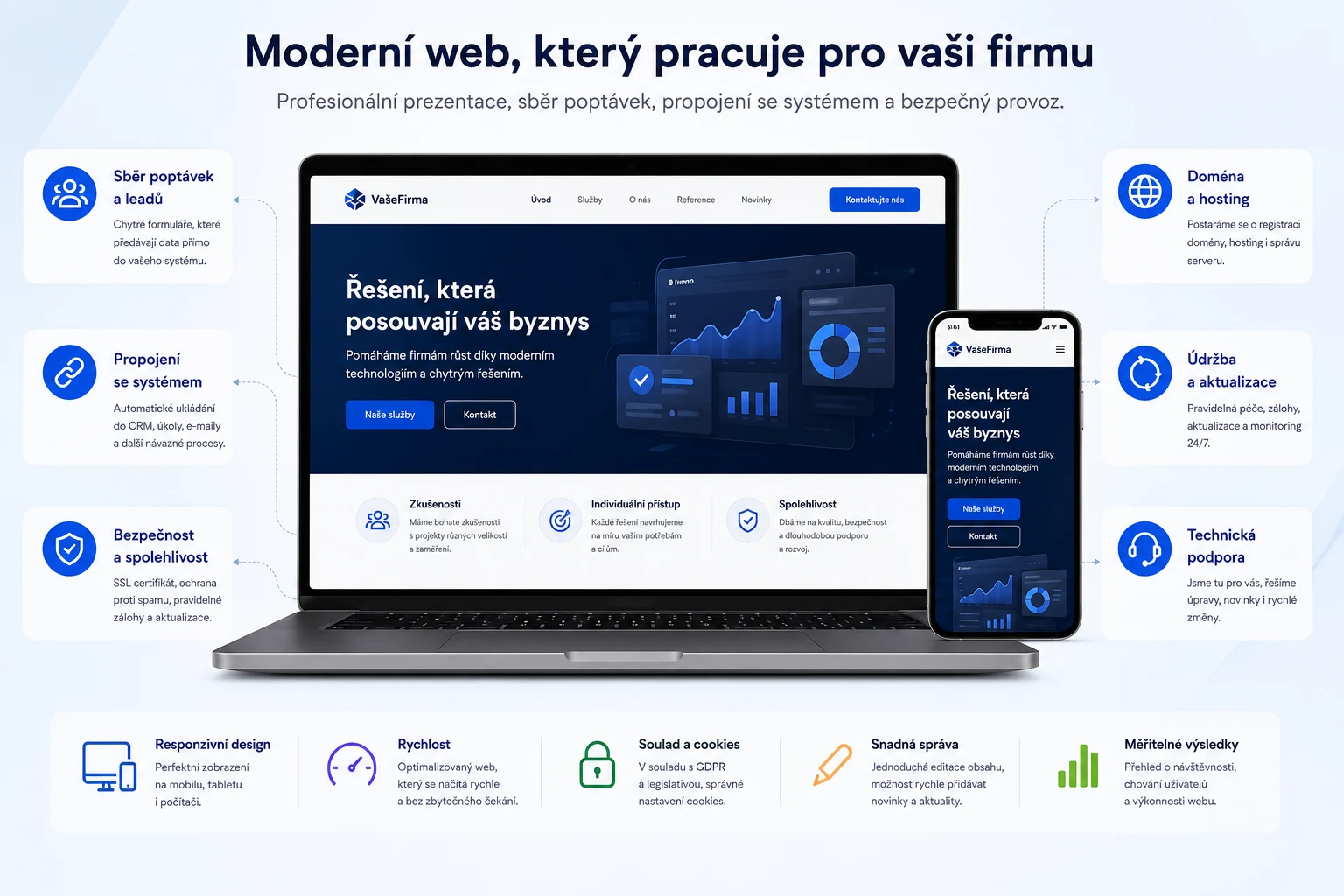
It is just as important to connect the website with the company’s other processes. Today, a website does not serve only for presentation, but very often also works as a tool for collecting inquiries and new contacts. A well-configured form can automatically pass information directly into the company system, notify the responsible person or trigger follow-up communication.
The inquiry form itself should also be well prepared and protected against spam. Details like these often determine whether a website truly helps the company or merely exists.
It is also important to remember that the website should match the company’s overall identity. It should be aligned with the logo, communication style, industry and brand values. If a company looks professional offline, it should create the same impression online.
Many companies feel that a quality website must automatically mean a huge investment. In reality, that is not always the case.
Simpler modern websites can now be created for tens of thousands of crowns, and in some cases it is enough to do a refresh of an existing website — a younger design, updated content, better structure or technical improvements. Even relatively small changes can significantly improve the overall impression of the company.
It is also good to keep in mind that a website is not something that is created once and then stays the same for the next ten years. Just as the company, services and technologies evolve, the website should gradually evolve as well.
A website administrator should be able to quickly add new information, adjust content or react to changes within minutes. Regular updates to both content and appearance help the company look active, modern and trustworthy.
It is also very important to realize that the work does not end when the website is created. The page itself is only the beginning. After that, you still need to deal with the domain, hosting, server management, security, updates, backups and ongoing maintenance.
The technical background of a website is often underestimated, even though it has a major impact on the security, speed and reliability of the whole solution. It is always good to have a person or company at hand that truly understands hosting, servers and website system administration.
Many problems do not arise from the website itself, but from badly configured hosting, outdated plugins, missing backups or neglected server management.
That is why companies today increasingly look for a complete solution where they do not only solve website creation, but also its long-term operation.
This can include services such as:
- domain registration and management,
- website deployment on a server,
- ongoing management and updates,
- technical maintenance,
- security,
- backups,
- monitoring,
- content updates and further development.
An existing website can also be transferred to new management without any problem, ensuring its continued operation without having to build everything from scratch.
This allows the company to avoid technical details and focus on its business, while management, security and the technical background are handled by an experienced partner.
Today there are several ways to build a website. Some companies prefer a fully custom-programmed solution, while others prefer systems such as WordPress, which allow easier content management and lower acquisition costs. Both options have their advantages and limitations, and it is good to address them at the very beginning based on the needs of a specific company.
The ideal situation is of course when a company knows exactly what it expects from the website. That is not always the case, however. In many situations, you can build on the original website, logo, communication style or overall company presentation and gradually move everything in a more modern direction.
A modern website today is not just a technical page or a marketing add-on. It is an important part of the brand, credibility and the company’s overall presentation toward customers and business partners.