Full text
Just a few years ago, most companies could get by with a few basic tools. Email, a simple calendar, Excel spreadsheets and a few separate applications for individual parts of the business.
Today, the situation is completely different.
Companies commonly use a CRM system, project management, company chat, cloud storage, online meetings, digital signatures, accounting software, mobile apps or various automation tools. Each part of the company often runs in a different system, and employees constantly switch between several applications throughout the day.
At first glance, this may not seem like a problem. But over time it becomes increasingly difficult to maintain order, continuity and clarity across the entire company.
Customer information is in the CRM, communication is in email, documents are in the cloud, contracts are in another service, tasks are in the project system and internal communication is in the company chat. The moment someone needs to quickly find the complete history of a project or customer, the endless searching across several different tools begins.
That is exactly why more and more companies today are looking for a way to unify most of their important processes into one environment.
A modern CRM or ERP system is no longer just a contact database or job record. It is becoming the center of a company’s daily operations. A place where sales connect to projects, communication connects to documents and documents connect to the next internal processes.
The goal is not to have as many features as possible. What matters is that everything works naturally and employees do not have to keep jumping into other applications while working.
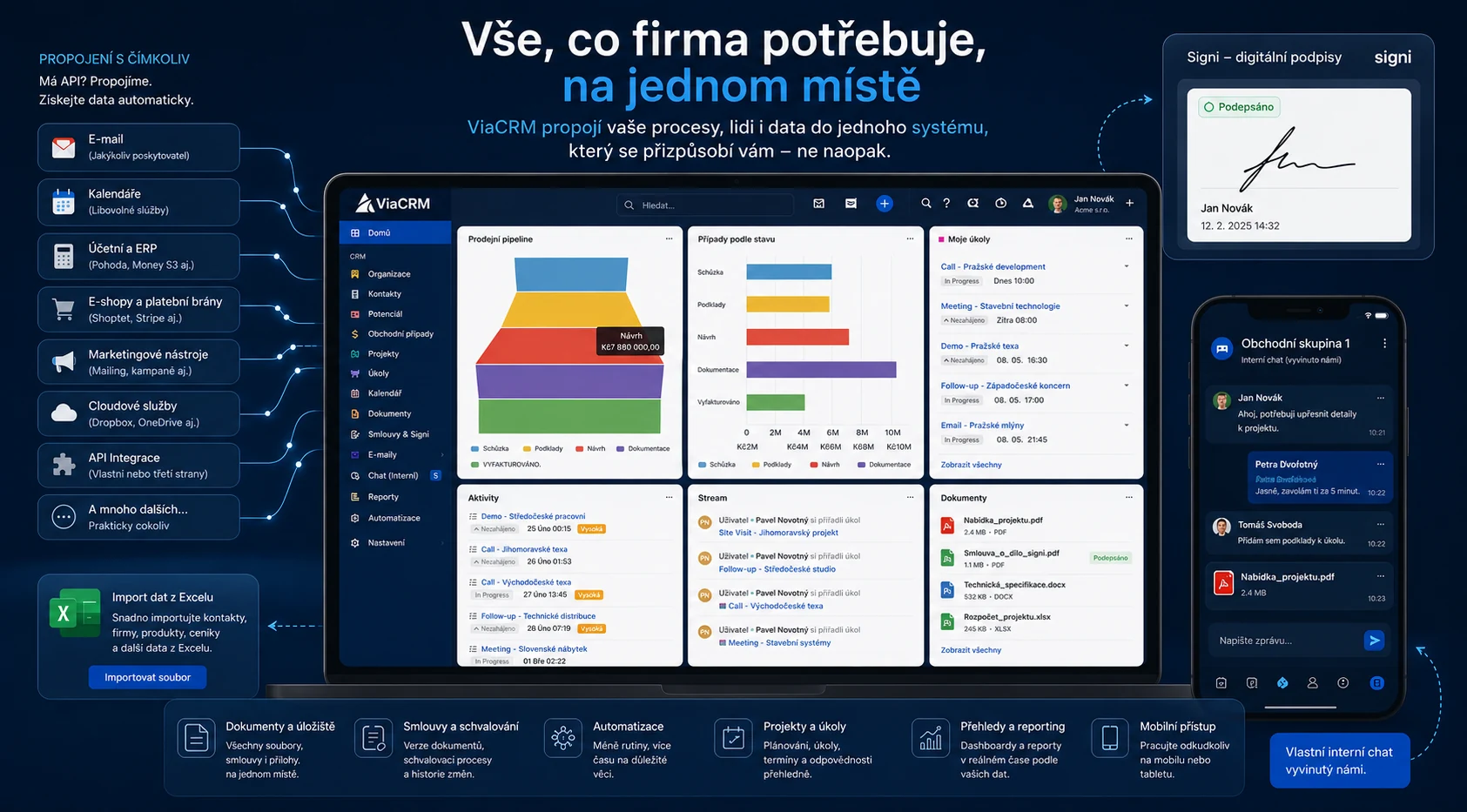
Today it is common for companies to want one system for sales communication, project management, internal chat, documents, contracts, meeting planning or digital signing. Just as important is integration with the other services the company already uses.
In practice, almost any modern application that offers an API interface can now be connected to a company system so that information is synchronized automatically and users do not have to enter the same data repeatedly in several different places.
Thanks to this, a company can work much more clearly. Employees always have what they need at hand and can focus on work instead of constantly searching for information or switching between tools.
Simplicity also plays a major role today. A system may contain dozens of functions, but if it is unclear or complicated, people stop using it. A modern business environment therefore has to be fast, intuitive and accessible from anywhere — from the office, from home and from mobile.
Every company also works a little differently. Some need a simple CRM for the sales team, others need a complex system connected to production, warehouse operations, documents or a mobile app. That is why more and more companies are looking for a solution that can adapt to their operations, instead of forcing the company to adapt to the limitations of an off-the-shelf system.
The trend of recent years is fairly clear. Companies are gradually moving away from dozens of separate applications and looking for one connected environment where everything important is in one place — from the first contact with a customer to the final signing of a contract.